Buying a home is one of the biggest financial decisions a person makes. While the location, price, amenities, and floor plan are important, the builder’s reputation and past performance can significantly affect the safety of your investment. A builder with a strong track record is more likely to deliver a project according to the agreed specifications, maintain construction quality, and follow the applicable legal requirements. On the other hand, a builder with a history of delays, disputes, or incomplete projects may expose buyers to financial and legal risks.
Before booking a flat, apartment, or independent house, buyers should investigate the developer rather than relying entirely on advertisements, sales representatives, or attractive sample flats. In India, several online platforms and official records can help you assess a builder’s credibility. Here is how to verify a builder’s track record before buying a property.
Check the Builder’s RERA Registration
One of the first steps is to verify the project’s registration with the relevant state Real Estate Regulatory Authority (RERA). Under the Real Estate (Regulation and Development) Act, 2016, qualifying real estate projects generally need registration before being advertised or sold, subject to applicable exemptions.
Visit the official RERA website of the state where the property is located. Search for the project or promoter using the available registration number or name.
Review important details such as:
- Project registration status and validity
- Promoter or developer details
- Approved project completion timeline
- Project layout and sanctioned plans, where available
- Construction progress and submitted updates
- Details of complaints, orders, or regulatory action, where published
Compare the information on the RERA portal with the claims made by the builder. If the promised possession date differs significantly from the registered completion timeline, ask for a written explanation.
Remember that registration does not guarantee a project’s quality or eliminate every risk. It is an important verification step, not a substitute for due diligence.
Research the Builder’s Previous Projects
A builder’s completed projects can reveal more about its reliability than promotional material. Identify at least two or three developments completed by the same developer, preferably in the same city and with a similar property type.
Visit these projects if possible. Observe the condition of common areas, lifts, parking spaces, staircases, drainage systems, and external walls. Look for signs of water leakage, cracks, poor maintenance, or unfinished facilities.
Also check whether promised amenities, such as a clubhouse, landscaped areas, security systems, and recreational spaces, were actually delivered.
If the builder has several projects under construction, examine whether they appear to be progressing consistently. A large number of unfinished developments may warrant further investigation, particularly if the developer has not provided a clear explanation.
Check Construction Quality and Maintenance
Construction quality affects the long-term safety, comfort, and maintenance costs of a property. During a site visit, examine the visible workmanship and the overall condition of completed buildings.
Pay attention to wall finishing, flooring, doors, windows, plumbing fixtures, electrical fittings, ventilation, and water drainage. Ask existing residents about recurring problems, including seepage, plumbing failures, lift breakdowns, and delays in maintenance services.
You should also ask whether the builder addressed defects reported after possession. A developer’s response to complaints can indicate how it handles customer service and post-possession responsibilities.
For a property involving a substantial investment, consider hiring an independent civil engineer or qualified building inspector. A professional can assess aspects of construction that may not be apparent during a routine visit.
Verify Project Delays and Possession History
Possession delays can increase rent expenses, loan interest costs, and financial stress. Therefore, check whether the builder has delivered earlier projects within their stated timelines.
Compare the original promised completion dates with the actual possession dates of previous developments. You can gather this information from RERA records, project documents, public notices, and discussions with existing buyers.
If a builder has experienced delays, investigate the reasons. Some delays may result from regulatory approvals, court orders, or other circumstances, while repeated delays across several projects may indicate broader planning or financial problems.
Ask the developer for a written possession timeline for the property you are considering. Avoid relying solely on verbal assurances that construction will be completed soon.
Read Customer Reviews and Speak to Existing Buyers
Online reviews can help identify recurring concerns, but they should not be treated as definitive evidence. Look for reviews across multiple platforms and focus on specific, verifiable complaints rather than general praise or criticism.
Common warning signs include repeated reports of possession delays, changes to promised specifications, hidden charges, poor construction, and unresponsive customer support.
Whenever possible, speak directly with residents of the builder’s completed projects. Ask whether the final property matched the agreement, whether amenities were delivered, and whether the builder resolved defects promptly.
Be cautious of unusually similar reviews or claims that cannot be independently verified. The goal is to identify consistent patterns rather than judge a builder based on one isolated comment.
Examine Legal Cases and Regulatory Complaints
A builder’s legal history can reveal potential risks that may not appear in advertisements. Search the relevant RERA website for published complaints and orders involving the developer. You may also review publicly accessible court records and consumer commission decisions.
Check whether disputes concern delayed possession, refund claims, misleading advertisements, construction defects, or violations of regulatory requirements.
The existence of a complaint does not automatically mean that the builder is unreliable. Consider the nature of the allegation, the outcome, whether the order was complied with, and whether similar disputes recur across multiple projects.
For a major purchase, consult a property lawyer to review relevant documents and assess any significant legal concerns.
Review Financial Stability and Business Background
A builder’s financial position can influence its ability to purchase materials, pay contractors, complete construction, and maintain project schedules.
Research the developer’s business history, years of operation, completed developments, and any publicly available financial disclosures. If the developer is a company, its filings may be available through the Ministry of Corporate Affairs.
For larger or publicly disclosed businesses, credit ratings and financial reports may provide additional information. However, not every builder publishes detailed financial data, and a lack of public information alone does not prove financial distress.
Ask whether the project has the required financial arrangements and whether the developer has disclosed any project-specific financing or encumbrances that could affect the property.
Verify Approvals and Property Documents
Even a well-known builder should be checked for project-specific legal compliance. Ask for the relevant documents and have them reviewed by an independent property lawyer.
Depending on the project and state, these may include:
- Land title documents and ownership history
- Encumbrance details
- Approved building plans
- Applicable commencement or construction permissions
- RERA registration details
- Occupancy or completion certificate, where applicable
- The agreement for sale and payment schedule
Do not assume that a builder’s brand reputation guarantees that every project has all necessary approvals. Requirements vary according to the property’s location, type, and stage of construction.
Compare Promises With the Written Agreement
Before paying a booking amount or signing an agreement, confirm that the carpet area, price, payment schedule, possession date, specifications, and promised amenities are accurately recorded.
Review clauses concerning delays, cancellation, refunds, defect liability, and additional charges. Ask the builder to clarify any vague or contradictory terms in writing.
Avoid making large payments based only on brochures, sample flats, or verbal commitments. Ensure that payments follow the applicable legal requirements and the terms of the agreement.
Conclusion
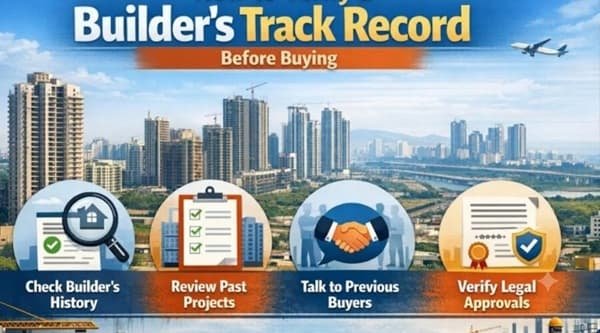
Verifying a builder’s track record before buying requires more than checking its brand name or online ratings. Review RERA records, inspect completed projects, speak to residents, investigate delays and complaints, assess available financial information, and verify the property’s legal documents.
A thorough background check can help you identify warning signs before committing your savings to a property. If anything appears unclear, seek independent legal or technical advice before proceeding. Taking these precautions can help you make a more informed decision and reduce avoidable risks when buying a home in India.
Frequently Asked Questions
Q. How can I check whether a builder is trustworthy in India?
Check the builder’s RERA registration, completed projects, construction quality, possession history, customer feedback, legal disputes, and project approvals. Verify important claims through official records.
Q. Is RERA registration enough to trust a builder?
No. RERA registration is an important compliance check, but it does not guarantee construction quality, timely possession, or complete legal safety. Additional verification is necessary.
Q. How can I check whether a builder has delayed previous projects?
Review project completion details on the relevant state RERA portal, compare promised and actual possession dates, and speak with buyers of completed projects.
Q. Should I consult a lawyer before buying a builder’s property?
Yes. An independent property lawyer can review title documents, approvals, encumbrances, and the sale agreement to identify potential legal risks.
Q. What are the major warning signs of an unreliable builder?
Repeated possession delays, unresolved complaints, missing approvals, unclear land titles, poor construction quality, unexplained charges, and pressure to make immediate payments are important warning signs.