Choosing between land and gold is a common investment dilemma for Indian investors. Both are traditionally viewed as ways to preserve wealth, protect purchasing power, and diversify an investment portfolio. Land attracts investors who want to own a tangible asset with potential long-term appreciation, while gold is popular for its liquidity, cultural significance, and role as a hedge during economic uncertainty.
However, neither investment is automatically better for everyone. Land can generate substantial returns in developing locations, but it involves legal verification, maintenance, and potentially high transaction costs. Gold is generally easier to buy and sell, but its price can fluctuate significantly, and physical gold may involve making charges, storage costs, and purity concerns.
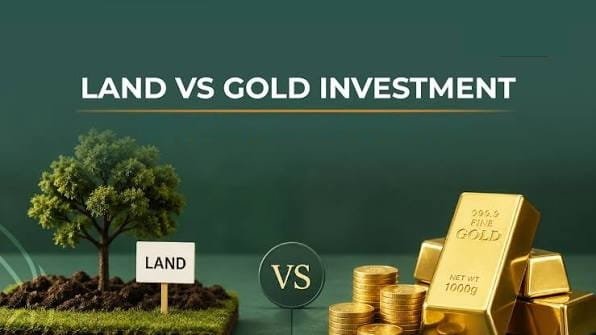
The right choice depends on your investment horizon, available capital, risk tolerance, liquidity needs, and financial goals. Understanding the differences between land and gold can help you make a more informed decision.
What Is Land Investment?
Land investment involves purchasing a plot for future appreciation, construction, resale, or a permitted commercial purpose. Investors may buy agricultural land, residential plots, or commercial land, depending on their budget and the applicable regulations.
Land prices can increase when an area experiences infrastructure development, better road connectivity, new employment opportunities, or rising housing demand. However, appreciation is not guaranteed. A plot in an area with weak demand or unresolved legal issues may remain difficult to sell for years.
Land generally requires a substantial initial investment, particularly in urban and rapidly developing areas. Buyers must also examine ownership records, land-use permissions, access roads, encumbrances, and local restrictions before purchasing.
What Is Gold Investment?
Gold investment involves purchasing the precious metal in physical form or through financial products linked to its price. Common options include gold jewellery, coins, bars, gold exchange-traded funds (ETFs), and eligible gold mutual fund schemes.
Physical gold is widely understood in India and can be sold through jewellers or other buyers, subject to their terms and the prevailing market price. Gold ETFs and mutual funds offer market-linked exposure without requiring investors to store physical gold themselves, although they involve their own costs and investment conditions.
Gold prices are influenced by factors such as international demand, interest rates, currency movements, central bank purchases, and geopolitical uncertainty. Gold can help diversify a portfolio, but its price may decline during certain periods.
Land vs Gold: Key Differences
| Factor | Land | Gold |
| Initial investment | Usually higher | Can start with a smaller amount |
| Liquidity | Generally low | Generally higher |
| Income generation | Possible through rent or lease, depending on use | Usually no regular income |
| Maintenance | May involve upkeep, taxes, and security | Physical gold requires safe storage |
| Legal requirements | Title, land use, and ownership verification are essential | Purity and authenticity must be verified for physical gold |
| Diversification | Concentrated investment in one location | Easier to hold in smaller amounts |
| Price drivers | Local demand, infrastructure, and development | Global prices, currency movements, and market conditions |
| Transaction costs | Can include stamp duty, registration, and legal fees | May include making charges, taxes, fund expenses, or trading costs |
These differences show why land and gold serve different purposes in an investment portfolio.
Which Investment Offers Better Returns?
Land can deliver strong long-term appreciation when purchased in a location with growing demand, infrastructure development, and economic activity. For example, a plot near a developing industrial corridor or expanding residential area may become more valuable as connectivity and local facilities improve.
However, returns depend heavily on the purchase price, location, holding period, and ability to sell the property. Land can also remain stagnant for years, and the costs of buying and selling reduce the investor’s net return.
Gold offers a different return pattern. Its price may rise during periods of economic uncertainty or when demand increases, but it can also experience substantial fluctuations. Gold does not depend on the development of a particular locality, making it a useful diversification option.
Neither land nor gold guarantees higher returns. Investors should compare actual returns after transaction costs, taxes, and other expenses rather than relying only on historical price increases.
Land vs Gold: Which Is Safer?
Land can provide a sense of security because it is a tangible asset. Nevertheless, it carries risks that investors sometimes overlook. Disputed ownership, fraudulent documents, unauthorised development, encroachment, and restrictions on land use can create serious financial problems.
Gold avoids many property-specific risks, but its market price can fall. Physical gold also carries the risk of theft, while jewellery may have making charges that are not recovered when sold.
For land, independent legal verification is essential. For gold, investors should check purity, authenticity, and the costs associated with their chosen investment method.
Which Is Better for Long-Term Investment?
Land may suit investors who have sufficient capital, a long investment horizon, and the ability to tolerate limited liquidity. It can be particularly attractive when the investor understands the local property market and can identify land with genuine development potential.
Gold may suit investors who want to diversify their savings, maintain a relatively accessible asset, or reduce dependence on equity and property markets. It is also easier to purchase gradually rather than committing a large amount at once.
Investors should remember that a long holding period does not automatically make either asset profitable. Purchase valuation, economic conditions, and investment costs remain important.
Tax and Other Costs to Consider
When buying land in India, investors may have to pay stamp duty, registration charges, legal fees, and applicable property-related taxes. Selling the land may also result in capital gains tax, depending on the asset’s classification, holding period, and prevailing tax rules.
Gold investments may involve GST on physical purchases, making charges for jewellery, and applicable taxes when sold. Gold ETFs and mutual funds may have fund expenses and other transaction costs. Tax treatment differs according to the investment product and the rules in force.
Before investing, calculate the expected net return after all relevant costs and verify the current tax treatment rather than assuming that land or gold receives more favourable tax treatment in every situation.
Should You Invest in Land or Gold?
Choose land if you have a substantial budget, can hold the investment for several years, and are comfortable with legal checks and the possibility of delayed resale.
Consider gold if you want a more flexible investment that can be bought in smaller amounts and is generally easier to liquidate. Financial gold products may be convenient for investors who want exposure to gold prices without storing jewellery or coins.
For many investors, a balanced approach may be more appropriate than choosing only one asset. The allocation should depend on financial goals, emergency savings, existing investments, and risk tolerance.
Conclusion
Land and gold offer different advantages. Land may provide long-term appreciation and, in some cases, rental or lease income, but it requires substantial capital and careful legal verification. Gold offers easier access, greater flexibility, and portfolio diversification, although its market price can fluctuate and it does not normally generate regular income.
The better investment depends on your circumstances. Rather than choosing based on popularity or past performance alone, compare the costs, risks, liquidity, and likely holding period of each asset before investing.
Frequently Asked Questions
Q. Is land a better investment than gold in India?
Not necessarily. Land may offer strong appreciation in suitable locations, while gold provides liquidity and diversification. The better choice depends on your goals, budget, and risk tolerance.
Q. Which investment is easier to sell, land or gold?
Gold is generally easier to sell. Land transactions may require more time because buyers need to assess the property, verify documents, and complete legal formalities.
Q. Can land generate regular income?
Yes, land may generate income through a lawful lease or permitted commercial use. However, income depends on the location, demand, and applicable regulations.
Q. Is gold suitable for beginners?
Gold can be accessible to beginners because investors can start with relatively small amounts. They should still understand price fluctuations, product costs, and the differences between physical and financial gold.
Q. Should I invest in both land and gold?
Holding both may help diversify your investments, provided the allocation suits your financial situation. Maintain adequate emergency savings and avoid concentrating too much wealth in illiquid assets.